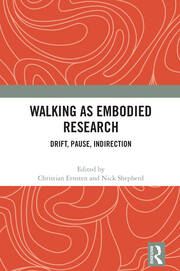
Contributions to this volume are by scholars, artists and practitioners drawn from a wide range of disciplines and fields, and from across the Global South and North. An overarching theme of the volume is the manner in which the act of walking brings the body into presence as a material part of the research process, and the forms of attentiveness that this encourages. Another theme is the intimate connection between the act of walking and the act of writing. As familiar landscapes change under the weight of Anthropogenic environmental change, walking becomes an act of witnessing and a spur to action. Rather than being a singular activity, walking itself is understood as a socially, economically and politically constructed and contested act. This volume will serve as a source of inspiration to readers from across the arts, humanities, and social sciences who are interested in walking methodologies and in new and sustainable research practices.
Publisher Routledge. ISBN nummer – 9781032010229. 300 hardcopy print. Editors: Christian Ernsten (Maastricht University) and Nick Shepherd (Aarhus University and the University of Pretoria)
Walking paths: ‘Homo Eclecticus’ about strolling, Jan Rothuizen
Amsterdam, 8 p.m.
The streets are almost empty. With every step I take, the snow crunches under my feet and I leave a black impression. I cross the normally traffic-laden junction diagonally toward the entrance of the Oosterpark. The park seems to be giving off light tonight. The snowy lawns suck the light out of the purple-yellow sky above them. I walk onto the big lawn in the middle of the park. After crossing it, I turn around and see my footsteps standing out like black blotches in the whiteness. My trail isn’t as straight as I assumed.
I’ve always strolled. Walking, ambling, moseying and shuffling has always been the state of being in which I find the words to say what I feel and think. As a walker I am a part of my surroundings and at the same time their observer. I am here and I am there. It’s in this hybrid mode that my thoughts and senses become more associative, and I discover who I am or want to be at that moment.
To me, the best walks are always despairing, endless, vague and euphoric discoveries of myself and the world I move in. Walking has turned out to be not only my salvation on a personal level but also as an artist: it is a manner of being to which I constantly return.
The drawings of my walks that I make as an artist consist of intricately drawn stories, a combination of text and images. What I can’t draw, I write down, what I can’t describe, I draw. The form is eclectic, and the storylines are nonlinear. In my drawings I combine the wide range of thoughts, emotions and sensations I experience while walking. In this essay, I try to ascertain while walking precisely what walking is and means to me.
Sarphatistraat 8.15 p.m.
I see other people for the first time, two women in long, quilted coats. Chattering, they cross the street obliquely.
I hear a crack as my shoe disappears into the snow. ‘Crack’. It’s a pity that I have to ruin the pristine, white surface with each step. ‘Crack’. But at the same time, there’s something ‘satisfying’ about it, as my eldest son would say. ‘Crack.’
Strolling through the snow, I remember the book Arctic Dreams by Barry Lopez. It has a drawing by Sunapignank, an Inuit who lives on an island in the Arctic Circle between Greenland and Canada. He drew the coastline where he hunts from memory, very precisely, with all its coves, inlets and even the islands before the coast.
Next to the drawing is an image of the same ragged coast made using modern cartographic techniques such as satellite images and geodesy. If you observe these two images side by side, you’d be amazed at how someone could render so meticulously from memory. His map is less precise despite the coves and little islands in front of the coast that it portrays. Most striking is the fact that his map is slightly more elongated, as if it had been drawn not from above but from a slight angle and at eye level, giving it the perspective of a walker.
One thing the book fails to mention is whether Sunapignank would have drawn this map of his own accord. It would seem unnecessary for someone who has assimilated his surroundings to such an extent. Why would you draw a map of something you know so well?
Amsterdam Oud Zuid 8.45 p.m.
Everyone is always completely alone for the first time at some point. For me, it was in New York in 1985. I was seventeen and travelling alone for the first time and it was my first visit to America. I didn’t really have any plans besides a big urge to go to New York, a city where I didn’t know anyone except for a friend’s brother at whose I could crash on the couch for the first few nights.
Wetering circuit 9.15 p.m.
Tonight, I don’t walk around it, but straight across. I once heard or read that here, between these very trees, is the geographical centre of the city. Everything is therefore equally distant and near to this open space. But what meaning does a centre have now that as blue, pulsating dots, we are always the centre of our own maps? I walk deeper into the old city, where the streets become narrower, and the houses lean against each other like old acquaintances.
In The New York Trilogy , a novel by Paul Auster, a detective follows someone through the streets of Manhattan. After shadowing him for days, he discovers that the routes the person he’s following takes are shaped like letters, letters that together form a message to him.
Long before people could know what the world looked like from outer space, the Nazca Lines were made in Peru. Between 900 and 200 BC, a monkey, birds and a dog with a long tail were rendered there. These animals, some of which are 275 metres long, are only visible from the air. The function and purpose of these drawings is still a matter of debate. Were they irrigation canals or symbols for deities up above? To me, they are mostly a form of early conceptual art, because the were a portrayal of things that existed at the time but couldn’t be seen by their creators.
The old city 9.40 p.m.
You can also see the Zeedijk down to each individual house on my favourite map of Amsterdam, a woodcut by Cornelis Anthonisz from 1544. It portrays the old city centre from an imaginary bird’s-eye view, a point about 400 metres up. The city is surrounded by a wall with towers and gates. Cornelis Anthonisz tried to render this map as accurately as possible, despite the general understanding that such a perspective didn’t exist.
I started walking as an artist in New York . The year before, I’d graduated in the Arts in the Netherlands, where I made large paintings that looked like the art I was familiar with in museums. After spending the summer in the Maine forests, I travelled to New York, where I wanted to continue my painting in the studio I had found there. But that didn’t happen. I always found an excuse for not starting to paint. I kept going out to buy brushes, paint or anything else, but later I would go out because I’d realised that I felt, thought and saw more while strolling through New York. I could no longer find what I needed within the studio’s isolation.
People have an average of 50,000 thoughts per day. Probably not all equally high-flown, but collectively, this sea of micro thoughts shows us the world as we experience it. And coming to think of it, it was this stream of impressions, smells and unexpected encounters that kept drawing me back out into the streets.
It took some time before my view on what it is that artists do changed, but once it did, I knew that the streets were my studio and that the strolls I took were my work.
In the book On a Clear Day You Can See Forever, I collected all my walks in text and drawings. That was also when I started drawing maps. For the blue map of the New York metropolitan area, I let all the thoughts and reflections that I’d collected during my strolls flow back into the streets, avenues and motorways of New York. This resulted in a street map of impressions, reflections and transcriptions of what I’d seen.
The abundance of details I observe and lists I make during my walks is overwhelming, but they give me an impression of the experience I want to portray in a drawing at that moment. The author of Robinson Crusoe, Daniel Defoe, is often credited as the inventor of the realistic narrative. His books tend to be experienced as realistic because he includes an endless number of insignificant details, so boring they could only be true.
Red Light District 10.10 p.m.
Homo Eclecticus
The amalgam of influences, sounds and memories: they’re all true, all welcome, and they come together in a big pot and for convenience’s sake, we’ll call the stock they produce ‘reality’.
Walking and thinking are interconnected but it seems as if while strolling, my thoughts are more connected to who I am at that moment, as if where I am is undetachable from who I am.
In De Renner , a book about cycling, the author, Tim Krabbé, writes that during intense physical exertion on his bike, every budding thought is immediately absolutely true and every unexpected occurrence becomes something you’d already always known. He describes his thinking as a pendulum, a smooth, black object that swings back and forth inside his head. I recognise the process of reducing thinking to true or false, bad or good while I walk.
Is arranging thoughts not in fact a meandering stream as opposed to a forced straight line? And am I, being a strolling thinker, a collector of things that have no apparent meaning but that together form a significant whole?
People sometimes say that they go for a walk in order to organise their thoughts. But that doesn’t apply to me. I in fact walk in order to disorganise my thoughts, to untangle the knot by letting it be and giving it free rein.
When I go out to get some fresh air, I allow myself to be distracted by a beeping car, the scents of a bakery, music coming out of an open window, the sunlight, the clouds, a yellow train riding through the green landscape. It’s this carefree chaos that eventually gives me the rhythm to come up with thoughts that I don’t need to write down because I’ve always had them and will never forget them, so natural and obvious that they don’t need to be explained.
Getting lost
Some people think that you’re only truly somewhere when you don’t know where you are. Only then are you able to see the place you’re in as it really is. Anyone who has ever got lost knows how unpleasant it is when your surroundings are completely unrecognisable.
I once saw a documentary about a man who would wake up every day thinking he’d lain in coma for years. It was caused by a malfunctioning short-term memory. Every time he’d see his wife, he’d burst into tears because he was convinced that it was the first time he’d seen her after many years. He was lost in time.
TAKE CARE
This was the inscription in white letters on a green sign we saw when entering the Cairngorms, the largest nature reserve in Scotland.
Prins Hendrikkade 10.38 p.m.
I’m not that good at getting lost, much as I would like to. Sometimes I even try to, but that’s quite a challenge in the Netherlands because almost all the tracks are part of some walking-path. It’s practically impossible to find a walking-path without signage because every square metre has been accounted for by some zoning plan.
I don’t know whether it’s an aberration but I’m always aware of where I am in relation to my surroundings. I have a spatial pattern in my head in which I move around. In Amsterdam, this pattern is intricate and in places where I don’t know my way around it’s a coarse-lined grid. But it’s always there. Is it something instinctual, animal, a remnant of the Neanderthal in me? Or is it a control thing, always wanting to know where I am?
My wife doesn’t have this problem, she never knows where she is. If she wants to indicate a place during a conversation, she points somewhere but more as a gesture. It always confuses me because the direction she points to is random and usually the wrong one.
Orientation is also simplification, plotting a street map in your head as a pattern in which you can place yourself—a recognisable environment.
The Uruguayan author Eduardo Galeano gives a completely different example of how we cling to things we know. He writes that Latin America wasn’t discovered by the Spanish but was conquered by them. These men, who came with a religion and dreams of gold, never really knew where they were. The Europeans remained lost, and, like other colonists, they gave the places they found the names of the places they’d left behind.
New Amsterdam, New York, Brooklyn is Breukelen—it’s a reaction I recognise in myself. The first days in a foreign country, I catch myself comparing everything with things I already know, as if I’m unable to see the new as an independent entity.
I keep my phone on during these walks. Besides my footprints in the snow, I leave a digital trail. I can save the details of my movements in a walking app, but even when the app isn’t on, my presence is stored in an anonymous data centre somewhere with a lot of space and few people.
I think that when you go somewhere you also leave something behind, not only digitally, or like I do now with my footprints in the snow, but also as an intangible presence.
Central Station 10.50 p.m.
The treadmill in the gym I go to has a screen that shows videos of different routes. Most are scenic, but the exception is also my favourite. It’s a walk along the San Francisco ‘waterfront’. There’s a park and a port where day-trippers hang around like cattle. You go by big sheds where events are organised and there’s a baseball stadium you have to go around. This waterfront route suits me because, like in real life, I’m curious about what the next bend will bring. I secretly hope to suddenly see the Golden Gate Bridge without knowing where it is.
Matthew Muspratt did a virtual 3,700-mile stroll across the United States with Google Street View. He clicked from West Quoddy Head, Maine all the way to Ozette, Washington. He started this walk through sixteen states when he was living in Rwanda and got homesick.
Muspratt said in an interview that there are boys who clicked from San Francisco to New York in ninety hours, but in Muspratt’s opinion, a true road trip isn’t a race. On the contrary: you need to slow down and maybe get a little lost. Muspratt noticed that he was clicking rhythmically, and that one place would evolve into the next. ‘Just like in the real world.’
This reminds me of On Exactitude in Science, a short story by Jorge Luis Borges about a kingdom where cartographers had made a life-size map of the country. The scale of the map is therefore 1:1.
But Photoshop is also part of how I see the world. In a place just outside Amsterdam where I like to walk, a big residential tower appeared one day, which disturbed the precise pattern of the meadows and the dikes. My reaction was to remove it digitally, the same way I erase smudges on my drawings with my computer.
Rokin 11.10 p.m.
I walk toward the square where a dam was built in a river and where this city once began. The Dam is now a big square with a war memorial and a dark palace.
The Soft Atlas
I decide to face the city, not in a suit of armour, but in a spotless white one and armed with a notepad in which I wrote down everything I saw and thought. My white suit was like a canvas on which the city I was travelling through would leave its mark. It bore like an imprint the traces of dust, sweat, dirt and scratches of the people I met. During these walks, I concentrated on my surroundings, the circle of my sensory perceptions, a way of working that reminded me of how bats find their way. A bat knows where it is by means of echolocation. The echoes of the high-pitched sounds it emits provide it not only with an image of its surroundings but also of who it is.
During a walk through Bulaq, an old working-class neighbourhood nearby the Nile, someone threw a dead rat at me. Maybe because with my white suit and notepad I looked like someone working for a property developer or something. Why someone would throw a dead rat at me isn’t important now. What I found interesting about it was that it made me aware of how variable a place could be. I knew I was walking through a poor working-class neighbourhood, but the dead rat instantly altered my image and mood. The city, which I had first perceived as cheerful, suddenly became hostile and unpredictable.
Meester Visserplein 11.30 p.m.
The British author, Jonathan Raban, wrote Soft City in 1974, in which he argues that what we think about a place is as important as the concrete things we can grasp and count. In other words: the essence of a place manifests itself where the imaginary and the physical experiences of it come together. Where the hard city, with everything we can measure and grasp, clashes with the soft city, the city we think and dream about and project our thoughts on.
The Soft Atlas is also the title of the collection of the more than 400 drawings that I made in the past ten years. These drawings have been previously published in books and newspapers and will be available under that title online from the summer of 2022.
In Space and Place, another book published in the seventies, the author and founder of humanistic geography, Yi Fu Tuan argues that the term ‘place’ is the reflection of a person’s subjective perspective. This explains why I prefer going on walks by myself: because that way I’m more perceptive to my surroundings and am less burdened with who I am. When I visit a place in order to make a drawing of it, I remain alert to inwardly directed sensations. For instance, if I walk through the centres of Bogotá or Medellín, I stick out as a ‘gringo’, whereas in more well-to-do areas, I’m barely aware of my European origin or skin colour.
Thinking back on the moment in 1995 when I gave up my studio in New York and decided that the street was my studio, I now realise I did something then that I wasn’t aware I was doing: by going out and meeting people I also partly gave up control over myself. You can keep the stories you create about yourself intact in the isolation of a studio with a door that can be shut but during a stroll in which you search for something without knowing what, you’re as receptive as the wind for encounters and occurrences you couldn’t have conceived of.
Alexanderplein 11.52 p.m.
I walk the last bit home with a smile on my face because a total stranger has just kissed my heart.
Amsterdam, January 2022
Translated from Dutch by Moshe Gilula
https://www.routledge.com/Walking-as-Embodied-Research-Drift-Pause-Indirection/Ernsten-Shepherd/p/book/9781032010229